How to read a resistor color code: 4 and 5 bands
Updated
A resistor's value is painted on, in three to six colored bands read from left to right. Learn ten colors and one rule and you can read almost any of them in a few seconds.
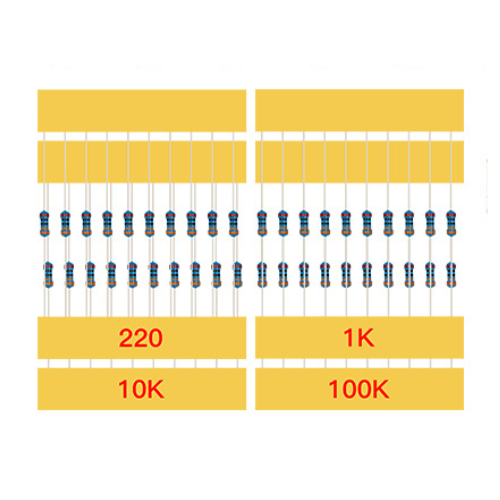
There's a catch most charts skip. Blue-bodied resistors, like the ones in our kits, usually have five bands, not four, and three of the four values in those kits start with the same three colors. Here's how to read both kinds, and how not to read one backwards.
The color chart
| Color | Digit | Multiplier | Tolerance |
|---|---|---|---|
| Black | 0 | ×1 | |
| Brown | 1 | ×10 | ±1% |
| Red | 2 | ×100 | ±2% |
| Orange | 3 | ×1,000 | |
| Yellow | 4 | ×10,000 | |
| Green | 5 | ×100,000 | ±0.5% |
| Blue | 6 | ×1,000,000 | ±0.25% |
| Violet | 7 | ×10,000,000 | ±0.1% |
| Grey | 8 | ||
| White | 9 | ||
| Gold | ×0.1 | ±5% | |
| Silver | ×0.01 | ±10% |
The digits run in rainbow order, red (2) to violet (7), with black and brown before them and grey and white after.
That rainbow order is the easiest way to remember it: black 0, brown 1, then red, orange, yellow, green, blue, violet for 2 to 7, then grey 8 and white 9. Gold and silver only ever appear as a multiplier or a tolerance, never as a digit.
Reading a four-band resistor
Four bands mean digit, digit, multiplier, tolerance. Hold the resistor with the gold or silver band on the right and read from the left:
- Write down the first two colors as digits.
- The third band says how many zeros to add after them.
- The fourth, usually gold, is the tolerance: how far the real value may be from the printed one.
Red, red, brown, gold: 2, 2, then one zero. 220 Ω, within 5%. Brown, black, orange, gold: 1, 0, then three zeros. 10,000 Ω, written 10 kΩ.
Because gold can't be a digit, it can only sit on the right, so four-band resistors are hard to read backwards. Five-band ones are not.
Reading a five-band resistor
Five bands mean digit, digit, digit, multiplier, tolerance. The extra digit is there because these are precision parts, usually 1%, shown by a brown last band, and three digits can mark values like 4.99 kΩ that two digits can't.
The 220 Ω in the Neon Realm kit reads red, red, black, black, brown: 2, 2, 0, then a black multiplier, which means ×1 and adds no zeros, then brown for 1%. 220 Ω.
This is where most people slip. On a four-band resistor the third band is the multiplier. On a five-band one the third band is a digit and the fourth is the multiplier. Count the bands before you read them.
The four values in our kits, in both codes
| Value | Five bands | Four bands | What it's for |
|---|---|---|---|
| 220 Ω | Red, red, black, black, brown | Red, red, brown, gold | In front of an LED |
| 1 kΩ | Brown, black, black, brown, brown | Brown, black, red, gold | A dimmer LED |
| 10 kΩ | Brown, black, black, red, brown | Brown, black, orange, gold | Pull-downs and light sensors |
| 100 kΩ | Brown, black, black, orange, brown | Brown, black, yellow, gold | Experiments with tiny currents |
Look down the five-band column. The 1k, 10k and 100k all start brown, black, black. Only the fourth band tells them apart: brown for one zero, red for two, orange for three. That's the band to read twice.
Which end do you start from?
On a five-band resistor both ends can be brown, so the colors alone don't always tell you. Use these clues, in order:
- The gap. The tolerance band usually sits a little apart from the others. Turn the resistor so the gap is on the right.
- The ends. The first band is usually closer to its end of the body than the last band is to the other end.
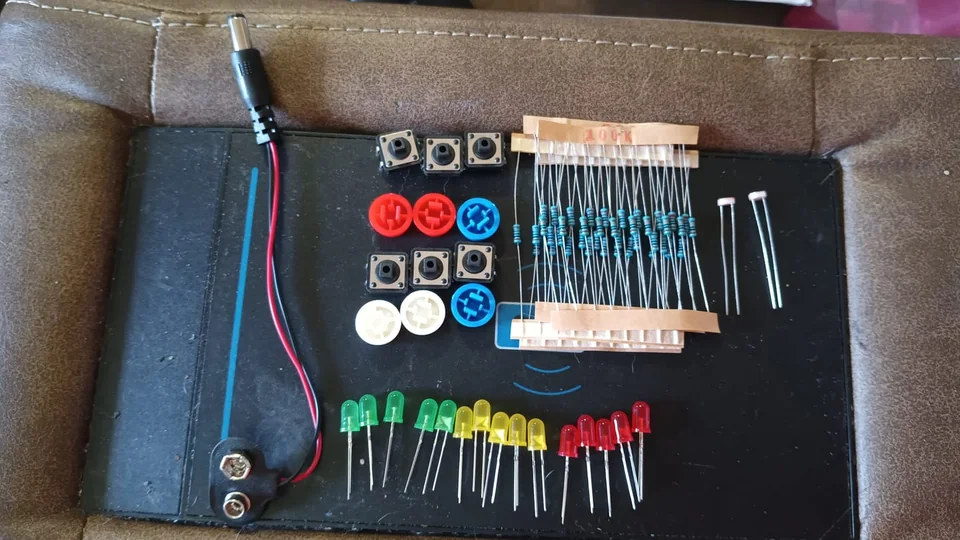
- The label. Our kits ship resistors taped to paper strips marked 220, 1K, 10K and 100K. Keep each one on its strip until a lesson calls for it, and you never have to read a band at all.
Here's why it matters. Read a five-band 220 Ω from the wrong end and you get brown, black, black, red, red: 1, 0, 0, then two zeros. That's 10 kΩ at 2%: a perfectly believable value, and one that's in the same kit. Read backwards, the other three come out as 110, 120 and 130 Ω, values the kit doesn't have, so those mistakes at least look wrong.
When it really matters, measure. A multimeter set to resistance (Ω) shows the value directly, whichever way round you hold the resistor.
Three bands, and six
- Three bands: digit, digit, multiplier, with no tolerance band at all. That means ±20%, and you'll mostly find them on old parts.
- Six bands: a five-band code plus a sixth band for the temperature coefficient, how much the value drifts as the resistor warms. Read the first five exactly as above.
Tiny resistors use numbers instead
Surface-mount resistors are too small to paint, so they carry three printed digits that follow the same rule: two digits, then the number of zeros. 221 is 22 and one zero, 220 Ω. 102 is 1 kΩ, 103 is 10 kΩ and 104 is 100 kΩ. An R marks a decimal point, so 4R7 is 4.7 Ω.
Why getting it right matters
Swap a 10 kΩ in where a 220 Ω belongs and an LED barely glows. Swap them the other way in a button's pull-down and the circuit wastes current every time the button's pressed. What resistor do I need for an LED? shows what each of the four values does to an LED, and the Resistor article covers pull-downs.
To practice, use the free browser simulator: right-click a resistor to change its value and its bands repaint to match. The simulator draws four-band parts, so it's good practice for the multiplier rule.
30 Days Lost in Space: 30 resistors in the four values above, on labelled strips, with the LEDs, sensors and HERO Board they're for, and 31 filmed lessons that tell you which one to use.
Questions
Which way do you read a resistor color code?
Left to right. On a four-band resistor, put the gold or silver band on the right. On a five-band one, put the band that sits slightly apart from the others on the right.
What is the difference between 4-band and 5-band resistors?
A five-band resistor has three digit bands instead of two, so it can mark more precise values. Five-band parts are usually 1%, with a brown last band; four-band parts are usually 5%, with a gold one.
What are the color bands on a 220 ohm resistor?
Red, red, brown, gold on a four-band resistor. Red, red, black, black, brown on a five-band one.
What are the color bands on a 10k resistor?
Brown, black, orange, gold on a four-band resistor. Brown, black, black, red, brown on a five-band one.
Does it matter which way round a resistor goes in a circuit?
No. Resistors work the same in either direction. Which way round you hold one only matters when you read its bands.